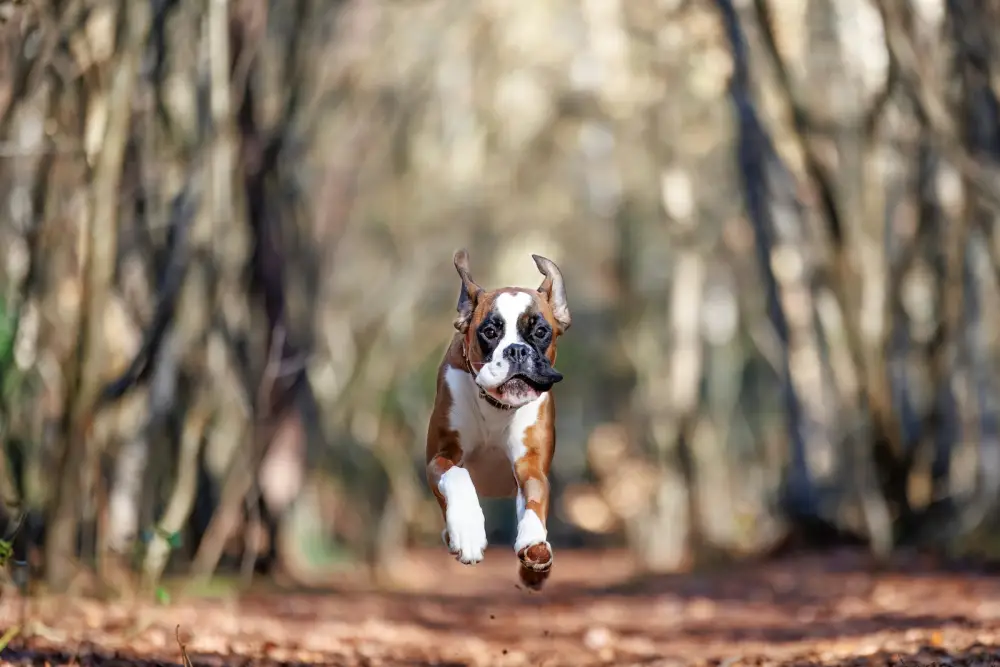
Boxer Training: The Eternal Puppy and the Owner Who Has to Lead

The Eternal Puppy Problem
Boxers don't grow out of it. That energy at 6 months? Still there at 6 years. The only thing that changes is how much damage they do without structure.
The pitch is irresistible: athletic, family-friendly, goofy, loyal, photogenic. The reality is that Boxers stay puppies — mentally, emotionally, behaviorally — until age 4 or 5. That's three to four years longer than most breeds, and three to four years of households assuming "he'll calm down eventually." He won't. Not on his own.
Owners assume the boundless puppy energy will fade by 18 months. It won't. Owners assume the jumping, the body-slamming, the impulse-driven chaos will resolve with age. It won't. The Boxer is what the Boxer is — and the breed requires a leadership style that most owners aren't prepared for.
Here's how to actually train one.
The Boxer Mind
Boxers are intelligent but emotionally driven. They do not respond well to repetitive, drill-based training. They need engagement, novelty, play, and clear handler relationship. They are not a "pattern-trained" breed like a Lab — they are a "relationship-trained" breed like a Doberman, but with more chaos.
This means training sessions need to be:
- Short (5 to 10 minutes max for adolescent Boxers)
- Variable (mix exercises, change environments, alter rewards)
- High-energy in delivery, calm in expectation
- Built on partnership, not control
The Energy Reality
Adolescent and young adult Boxers (1 to 4 years) have enormous energy. Not Border Collie energy — but explosive, athletic, body-slamming energy that can knock over children, elderly relatives, and uncoordinated guests.
Daily exercise minimums for an adult Boxer in South Florida:
- 60 minutes of structured walking or running (pre-7 AM and post-8 PM in summer)
- 20 to 30 minutes of mental engagement (training, scent work, puzzle feeders)
- Multiple short play sessions throughout the day rather than one long burnout
- Pool time when available (Boxers often love water and it satisfies energy without heat risk)
The Heat and Brachycephalic Reality
Boxers have a moderately brachycephalic structure — the muzzle is shorter than ideal for a working dog, which compromises their ability to cool themselves. South Florida heat is genuinely dangerous for this breed. Every word of our heat safety protocol applies, with extra urgency.
Specific Boxer heat rules:
- Never exercise after 8 AM or before 8 PM in summer
- Never exercise in direct sun, period
- Watch breathing constantly — labored breathing is the first sign of overheating
- Cool the dog at the first sign of distress (wet towels on belly, fresh water, immediate shade)
- Pool exercise is the safest summer option
The Jumping and Body-Slamming Issue
The single most common Boxer training complaint: the dog jumps on everyone, body-slams family members during play, and uses physical contact as their primary communication. At 50 to 70 pounds, this is a real injury risk for kids and elderly visitors.
The fix is the same as the jumping protocol we covered for all dogs — place command at the door, structured greetings, no attention for jumping. With a Boxer specifically, the protocol has to be enforced more consistently because the breed self-rewards through physical contact even when the contact is mild. A 10% lapse with most breeds produces a 10% jumping problem. A 10% lapse with a Boxer produces a 50% jumping problem.
The Boxer's solution is full enforcement, all the time, by every household member, with zero tolerance for the behavior. Three weeks of perfect consistency fixes most cases. Three weeks of inconsistent enforcement fixes nothing.
The Mouthiness Challenge
Boxers are mouthy. They use their mouths to play, to communicate, to investigate, and to engage. Without clear training, the mouthiness becomes a problem — bruised hands, ripped clothes, uncomfortable interactions with guests.
The fix: redirect the mouth into appropriate outlets (tug toys with strict on/off command structure, structured fetch with mouth manners), and apply consistent consequences for teeth on skin (verbal correction, brief social isolation, return to engagement only when calm). Boxers respond to clear feedback. They struggle with vague disapproval.

Training the Boxer
Foundation
Same skills as every breed, with one Boxer-specific note: the place command is especially important because it's the off-switch this breed lacks naturally. A Boxer who can hold a 30-minute place command is a Boxer who can be welcomed in friends' homes, calm during family gatherings, and reliable around the kids. Without place, the Boxer is the chaos at every event.
The Adolescent Reckoning
Boxers go through a particularly rough adolescent phase from about 10 to 24 months. They lose focus on previously known commands. They test boundaries hard. They seem to forget everything they learned. This is normal and developmentally expected.
The fix: hold the structure, increase enforcement consistency, lean on the foundation. Adolescence passes faster when the rules don't change. It lasts indefinitely when the owner gives in.
Socialization
Boxers are typically friendly with people but can be dog-selective in adolescence. Early, structured socialization with appropriate adult dogs (not just dog parks) is critical. Without it, the friendly Boxer puppy can become a frustrated greeter or selectively reactive adult.
The Common Boxer Cases
What we see most often:
- Adolescent Boxers (1 to 3 years) who have become uncontrollable jumpers and body-slammers
- Dogs who can't settle, even after extensive exercise
- Family Boxers who are dangerous around toddlers due to physical play style
- Heat-related issues during owner training mistakes (mid-day walks gone wrong)
- Selectively dog-reactive Boxers in their 2-4 year window
- Boxers who can't handle being left alone (the breed often develops mild separation issues)
The Move
If you own a Boxer in South Florida and the eternal puppy phase is wearing you down, the breed isn't broken — your structure is. The Boxer rewards consistent leadership and resists everything else.
Book a free assessment or text 786-755-5857. We'll evaluate the dog, the family dynamic, and the structure needed to turn Boxer chaos into Boxer charm.
Structure creates calm. Calm creates reliability. Even with a 70-pound puppy who's never going to fully grow up.
The Boxer Senior Reality
Boxers are prone to several serious health issues — cancer, heart disease, hip dysplasia. The breed's average lifespan is 9 to 11 years, shorter than most medium breeds. This means: the structural training you install in the first 2 years has to last because retraining a 7-year-old Boxer with health considerations is much harder. The investment in early training pays back across the dog's whole life — and it makes the older years easier to manage as health issues develop.
The Final Word on Boxers
The Boxer who is truly trained is one of the best family dogs alive — affectionate without being needy, athletic without being neurotic, protective without being aggressive. The eternal-puppy quality stops being a problem and starts being a feature. The work makes the difference.
Case in Point
My sixteen-month boxer was an apartment hurricane. Zoomies at midnight, jumping on every guest, ricocheting off the couch. Andre's read was simple: I had to drain her drive before I asked her to be calm. Structured exercise in the morning, place command before guests, real off-switch work. Four weeks later, she was a different roommate.
— Erin, Brickell
Book a Free AssessmentYour Boxer's Energy Isn't the Problem
The lack of structure is. Free assessment -- 786-755-5857
Book Free AssessmentUnleash'd K9 | North Miami, FL | unleashdk9.com | 786-755-5857
Making Sit Happen.