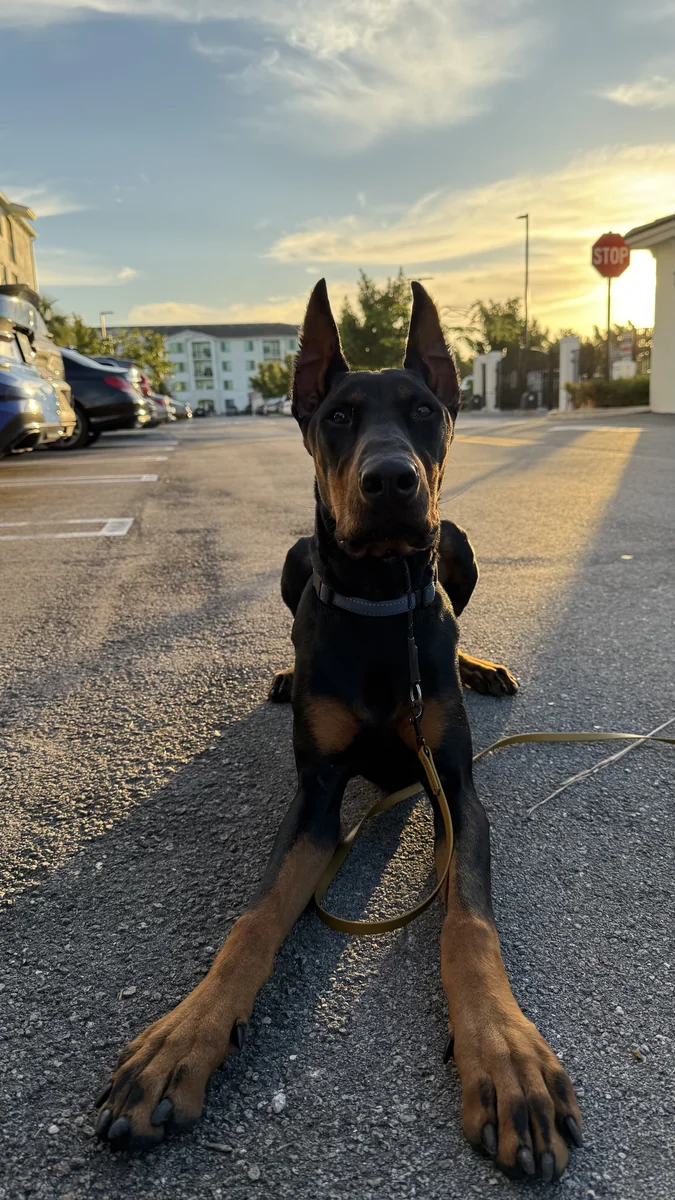
Doberman Training: Building the Confident, Stable Working Dog

The Velcro Dog With a Reputation
Dobermans were bred to guard, protect, and think independently. If you're not providing leadership, they'll provide their own. And you won't like the decisions they make.
The Doberman Pinscher is one of the most elegant, intelligent, and misunderstood breeds I work with in South Florida. They look intimidating. They can be intimidating. But underneath the sleek exterior is a deeply sensitive, handler-focused dog that bonds harder than almost any other breed — and that bond is both their greatest strength and their biggest vulnerability. Here's the honest training guide from a balanced trainer who works with them regularly.
The Doberman Temperament
Dobermans are working dogs — bred for personal protection, guarding, and handler partnership. They are not independent like a Husky or aloof like a Shiba Inu. They are Velcro dogs. They want to be with their person at all times, they read emotional states with incredible accuracy, and they take their cues from your energy.
This means a confident, structured owner produces a confident, stable Doberman. An anxious, inconsistent owner produces an anxious, reactive Doberman. The breed amplifies whatever you give it.
The Anxiety Problem
The number one issue we see in Doberman clients at Unleash'd K9 is anxiety — not aggression. Separation anxiety, noise sensitivity, environmental anxiety, and generalized nervousness. Dobermans who don't have enough structure, enough mental stimulation, or enough leadership often develop anxious behaviors: pacing, whining, destructive chewing, self-mutilation (lick granulomas), and hyper-vigilance.
The fix is always structure. A Doberman with a clear daily routine, structured exercise, crate training, and consistent obedience work is a calm, confident dog. A Doberman who free-roams a house all day with no schedule and no expectations is a ticking anxiety bomb.
Separation Anxiety Specifically
Dobermans are overrepresented in our separation anxiety caseload. The breed bonds so intensely that being left alone triggers genuine panic in many dogs. The fix is a structured departure protocol built on crate training. The dog learns: you leave, the crate is the safe place, you come back. The departures are boring. The returns are boring. The drama is removed from the equation.
If your Doberman is destroying the house, barking for hours, or injuring themselves when left alone, this is not something to wait out. Book a session and address it with structure before the behavior entrenches.
The Socialization Window
Dobermans who are not thoroughly socialized become suspicious of novelty — new people, new environments, new dogs. That suspicion is already genetically present in the breed. Socialization doesn't remove it, but it gives the dog a framework for handling new experiences without defaulting to reactivity.
Follow the standard socialization protocol with extra emphasis on:
- People of all types approaching calmly (the breed tends to be wary of strangers reaching over their head)
- Urban environments — Brickell sidewalks, Coconut Grove cafes, Wynwood crowds. The Doberman needs to be neutral in busy settings
- Handling by strangers — vet exams, grooming, anyone who needs to touch the dog
- Novel surfaces and sounds — the breed can develop noise sensitivity if not exposed early
Client case: Dante, a 2-year-old Doberman in Coral Gables, was destroying his owner's home office every time she left for yoga — baseboards, couch cushions, once a laptop charger. Classic separation anxiety. 4-week Board and Train with a structured crate-departure protocol. Dante now naps through her 90-minute studio classes on Alhambra without a single destroyed item.
Obedience and Drive
The Doberman is one of the most trainable breeds alive. They learn fast, they retain well, and they genuinely enjoy working with their handler. The flip side: they learn bad habits just as fast as good ones. If you're sloppy with your commands, inconsistent with your rules, or rewarding unwanted behavior accidentally, the Doberman will pick it up instantly.
Foundation Skills
Same as every breed at Unleash'd K9: sit, down, place, heel, recall, threshold control, impulse control. The Doberman typically masters these faster than most breeds — often within 2 to 3 weeks of consistent daily work. The challenge isn't teaching the skill. It's maintaining it with the same consistency the dog learned it with.
Engagement Work
Dobermans thrive on engagement — focused interaction between handler and dog. Eye contact games, directional changes on walks, surprise recalls, environmental searches for hidden treats. This breed wants your attention and will work hard to earn it. Use that drive.
Physical Exercise
Dobermans need significant daily exercise. 60 to 90 minutes of structured activity — not just a trot around the block. Running, swimming, structured fetch with obedience breaks, long-line work in open fields. In South Florida's heat, adjust timing — early morning and evening only during summer. The breed's dark coat and lean build make them vulnerable to both heat and cold, though heat is the relevant concern in Miami.
The Protection Instinct
Every Doberman owner needs to understand: the breed has a natural guarding instinct. This is not something you need to "train into" them. It's already there. The question is whether it's managed or unmanaged.
An unmanaged protection instinct looks like: barking at every person who approaches the front door, lunging at strangers on walks, resource guarding the owner from other family members, and escalating to bites when the dog perceives a threat that isn't there.
A managed protection instinct looks like: the dog is alert and aware, but defers to the handler's judgment. If the handler is calm, the dog is calm. If the handler says "free," the dog relaxes. The dog trusts the handler to manage the environment, so the dog doesn't have to.
Managing the protection instinct requires structure, socialization, and clear leadership. If you're not providing those three things, the Doberman will make their own decisions about who is and isn't a threat. And their decisions will not match yours.
Health Considerations That Affect Training
Dobermans have breed-specific health issues that directly impact training:
DCM (Dilated Cardiomyopathy): This breed is predisposed to heart disease. Know your dog's cardiac status before starting any high-intensity exercise program. Annual cardiac screening (echo and Holter) is recommended starting at age 2.
Wobbler Syndrome: Cervical instability can cause neck pain and coordination issues. If your Doberman is reluctant to hold positions, stumbles, or shows neck sensitivity, get a veterinary evaluation before assuming it's a training issue.
Von Willebrand Disease: A blood-clotting disorder. Relevant if you're using any training tools that could cause abrasion. Know your dog's vWD status.
The Right Program for Dobermans
At Unleash'd K9, we see Dobermans in both private sessions and board and train. The right choice depends on the same factors as any breed — severity of the issues, owner time commitment, and the home environment.
For anxiety-based cases (separation anxiety, noise sensitivity, generalized anxiety), private sessions with a structured home protocol usually get the best results because the owner needs to implement the changes in the home environment.
For obedience foundation and behavior modification (reactivity, aggression, lack of impulse control), the board and train provides the immersive reset that Dobermans respond well to. The breed adapts quickly to new environments and new handlers — their handler-focused nature means they bond to the training structure fast.
The Move
If you own a Doberman in South Florida and you're seeing anxiety, reactivity, over-protectiveness, or inability to settle, the breed isn't the problem. The structure is. Fix the structure, and you'll unlock the most loyal, capable, impressive dog you've ever owned.
Book a free assessment or text 786-755-5857. We'll evaluate the dog, the dynamic, and the home environment, and tell you exactly what needs to change.
Structure creates calm. Calm creates reliability. And a reliable Doberman is a thing of beauty.
Client Story
"I bought my dream dog, a blue purebred European Doberman I named Klaus. Klaus tested me in every way possible to the point I decided I needed help. Andre took him for two weeks. I gave him a bad kid and he returned to me a well-behaved teenager — Klaus stays in place, listens, doesn't pull on his leash. We now have the tools to work with him as a family."
— Daniella, Google Review
See the Board & Train ProgramYour Doberman Was Bred to Work
Give them a job. Free assessment -- 786-755-5857
Book Free AssessmentUnleash'd K9 | North Miami, FL | unleashdk9.com | 786-755-5857
Making Sit Happen.