The Bite-Free Dog: 5 Warning Signals Most Owners Miss

The Five Signals That Save Lives
Almost every dog bite is preceded by warnings. The dog tells the owner, the visitor, the child — repeatedly, sometimes for weeks — that they are uncomfortable. The bite happens because the warnings were missed.
Reading dog body language isn't optional. It's the foundational safety skill of dog ownership. A family that knows the warning signals can prevent virtually every avoidable bite. A family that doesn't is rolling the dice every time the dog is in a new situation.
Here are the five signals that come before most bites. Learn them. Teach them to your kids. Watch for them every time the dog interacts with anyone or anything new.
The Bite Ladder
Aggression is a ladder, not an event. Dogs climb it from low-intensity warnings to high-intensity contact. The five signals below are the rungs most people miss before the dog reaches the bite at the top.
These are not in absolute order — every dog escalates differently — but they are the most common warning patterns we see in clients with bite history.
Signal 1: Lip Licking and Yawning (Outside Context)
A dog yawning while waking up is a yawn. A dog yawning when a stranger approaches is communication. A dog licking their lips after eating is normal. A dog licking their lips when a child reaches toward them is a warning.
These behaviors are stress signals. They appear when the dog feels uncomfortable but isn't yet ready to escalate. Most owners completely miss them because they look like normal behavior in the wrong context.
What to do: notice the context. If your dog yawns or lip licks when a specific person, dog, or situation appears, that's information. Remove the dog from the situation. Don't push them. The dog is asking for space. Give it.
Signal 2: Whale Eye
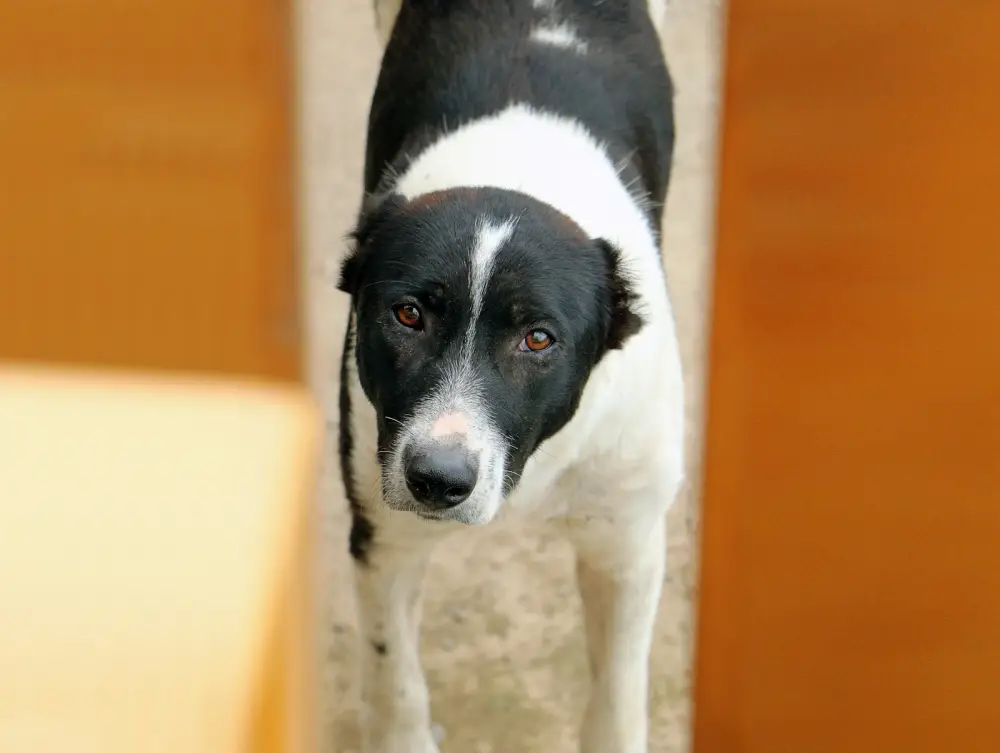
Whale eye is when you can see the white of the dog's eye while the dog turns their head slightly away from a trigger but keeps the trigger in view. The body language says: "I want to leave but I can't take my eyes off the threat."
This is high-stress avoidance and it precedes many bites. A dog showing whale eye is over threshold. They are seconds or minutes from escalating.
What to do: immediately remove the dog from the situation. Do not insist they "say hi" to whatever they're whale-eyeing. Do not let children approach. Get distance. Let the dog reset.
Signal 3: Body Stiffening
A relaxed dog has loose, fluid body language. Their muscles move easily. Their tail wags from the hip. Their mouth is soft, sometimes slightly open.
A dog who is about to escalate stiffens. The body becomes still. The tail may freeze in place (high or low, but not wagging). The mouth closes. The dog appears to "freeze."
Body stiffening is a final-stage pre-aggression signal. It is the moment before the snap, the lunge, or the bite. If you see it, you have seconds.
What to do: do not approach the dog. Do not reach for the collar. Call the dog away if they have a reliable recall, or back away yourself if they don't. Do not punish. Just create distance immediately.
Signal 4: Hard Stare
Most dog stares are soft. The eyes are relaxed. The dog blinks normally. Eye contact is comfortable and brief.
A hard stare is fixed. The eyes lock on the target. The dog doesn't blink. The stare may be accompanied by a stiff body and a low growl.
The hard stare is a clear warning. The dog has identified a target and is preparing to escalate. In a multi-dog household, hard staring between dogs is one of the most reliable predictors of an imminent fight.
What to do: break the stare. Move the dog. Block their line of sight. Do not punish — that increases arousal. Just interrupt the focus pattern.
Signal 5: Lifted Lip (Subtle, Sometimes Mistaken for a "Smile")
A dog who lifts their lip slightly to expose teeth — even briefly — is sending a clear warning. This is sometimes called a "snarl" but it can be subtle enough that owners mistake it for a smile or a quirky face the dog makes.
It is not a smile. It is a final warning before a snap or bite. The dog is showing their weapons because they expect to need them in the next moment.
What to do: take it seriously every single time. Remove the trigger or remove the dog. Do not punish the lip lift — punishing warnings teaches the dog to skip the warning and go straight to the bite. That's the opposite of what you want.
The Most Dangerous Mistake
The single most dangerous thing dog owners do: punish the growl.
A dog who growls is communicating. A dog who growls and gets punished learns that growling brings consequences. The dog suppresses the growl. The dog still feels uncomfortable in the same situations. The dog skips the growl and goes directly to a bite — because the warning system has been removed.
Never punish a growl. Never punish a snarl. Never punish a lifted lip. These are warnings. They are gifts. They tell you the dog needs space, and they give you the chance to provide it before anyone gets hurt.
If your dog is growling at things, the answer is to address why they're uncomfortable — not to teach them to stop telling you.
Teaching Children to Read the Signals
Kids cannot reliably read dog body language. They miss the signals. They push past warnings. They reach toward dogs who are signaling clearly that they want to be left alone.
This is the source of most dog bites to children — not "bad dogs," but kids interacting with dogs who were giving warnings the kids couldn't read.
Family rules that prevent most child bites:
- Children do not approach a dog who is sleeping, eating, or chewing
- Children do not hug, kiss the face of, or sit on top of dogs
- Children do not corner dogs or chase them when the dog is moving away
- Children always ask before petting any dog, including their own
- Adults always supervise child-dog interactions, every time
If you have children and a dog, drill these rules constantly. The cost of one bite to a child — emotionally, medically, legally — is permanent.
The Multi-Dog Household Application
In multi-dog households, the warning signals become predictors of fights. Watch for:
- Hard staring between dogs (especially over food, toys, or sleeping spots)
- Body stiffening when one dog approaches the other
- Lip lifting between dogs
- Whale eye in the lower-status dog when the higher-status dog approaches
These signals predict fights with high reliability. If you see them, intervene with structure (separate the dogs, redirect to place command, manage the resource that's triggering the conflict). Don't wait for the fight to confirm what the body language already told you.
Client case: A family in Pinecrest called us after their Rhodesian Ridgeback, Kofi, nipped their 7-year-old daughter's hand. Once we reviewed the history, the dog had been whale-eyeing and lip-licking around the kids for months — they'd missed every warning. Private sessions plus a full household education protocol. Kofi now settles on place whenever the kids have friends over, and the parents actually see the signals before they escalate.
When Professional Help Is Required
If your dog has growled at a family member, snapped at a visitor, lunged at a child, or shown the warning signals on a regular basis, this is not a wait-and-see situation. Get professional help.
For warning-stage cases — where the dog is signaling but hasn't bitten yet — private sessions are usually the right entry point. We can identify the triggers, build the management plan, and address the underlying reasons for the discomfort.
For dogs who have already bitten with skin contact, the 4-week board and train is typically the right reset. The dog needs distance from household triggers during the foundation rebuild, and the family needs the trained dog returned with full transfer protocols.
The Move
Reading dog body language is not optional. If you missed the signals leading up to a bite, get professional help to make sure you don't miss them next time. If you're seeing the signals now and the dog hasn't bitten yet, you have a window to fix the issue before someone gets hurt.
Book a free assessment or text 786-755-5857. We'll evaluate the dog, identify the triggers, and build a plan that addresses the underlying discomfort — not just the surface behavior.
Structure creates calm. Calm creates reliability. Reading the signals is the difference between a near-miss and a hospital visit.

Ready to Get Started?
Book a free assessment to evaluate your dog's behavior, discuss your goals, and find the right program. No pressure — just honest answers from a working trainer.
Book Free AssessmentView All Programs
Unleash'd K9 | North Miami, FL | unleashdk9.com | 786-755-5857
Making Sit Happen.