Door Dashing: The Habit That Gets Dogs Killed

The Habit That Kills Dogs
Door dashing is the behavior that gets dogs killed faster than any other. Loose dog runs out the front door. Loose dog runs into traffic. Loose dog is hit by a car within minutes of escape. Or loose dog runs into the yard, the gate is open, loose dog is gone for hours, days, sometimes forever.
Every year in South Florida, hundreds of dogs are lost or killed because they dashed through an open door. Almost all of these incidents are preventable. The fix is one of the most teachable skills in dog training. The reason it's not taught more widely is that owners don't take door dashing seriously until something terrible happens.
Here's how to fix it before that happens.
Why Dogs Door Dash
Dogs dash through open doors because:
- The outside is more interesting than the inside
- They've successfully done it before and self-rewarded
- They have no impulse control around thresholds
- The door is a high-value resource (it leads to walks, freedom, the world)
- They've never been taught that doors are not free passes
Door dashing is not a "naughty" behavior. It's the absence of a trained behavior. The dog has never been taught that thresholds require permission. The door opens, the dog goes — that's the default in the absence of training.
Client case: A Husky named Koda in Weston bolted through his family's front door three times in one month — twice across Indian Trace, once into a neighbor's garage. They were terrified to open the door for Amazon. 4-week Board and Train with heavy threshold work. Koda now sits and waits at the front door while the Uber Eats guy hands over sushi — doesn't move until his owner says "free."
The Threshold Control Foundation
The fix is called threshold control. The dog learns: I do not move through any threshold without explicit permission from the handler.
Every doorway in the house. Every gate. The car door. The crate door. Every threshold becomes a controlled point where the dog waits, makes eye contact, and is released through with a verbal command.
This is not an advanced skill. It's a foundation skill. We teach it to every dog in our puppy program and every dog in board and train, regardless of the presenting issue, because threshold control underpins so many other behaviors:
- Door dashing prevention
- Calm guest greetings
- Polite walking through doorways together
- Safe car loading and unloading
- Reliable crate training
- General impulse control development
A dog who understands thresholds is a dog who understands that you are leading and they are following — across every transition in the day.
The Step-by-Step Training Protocol
Phase 1: Indoor Doorways (Days 1 to 7)
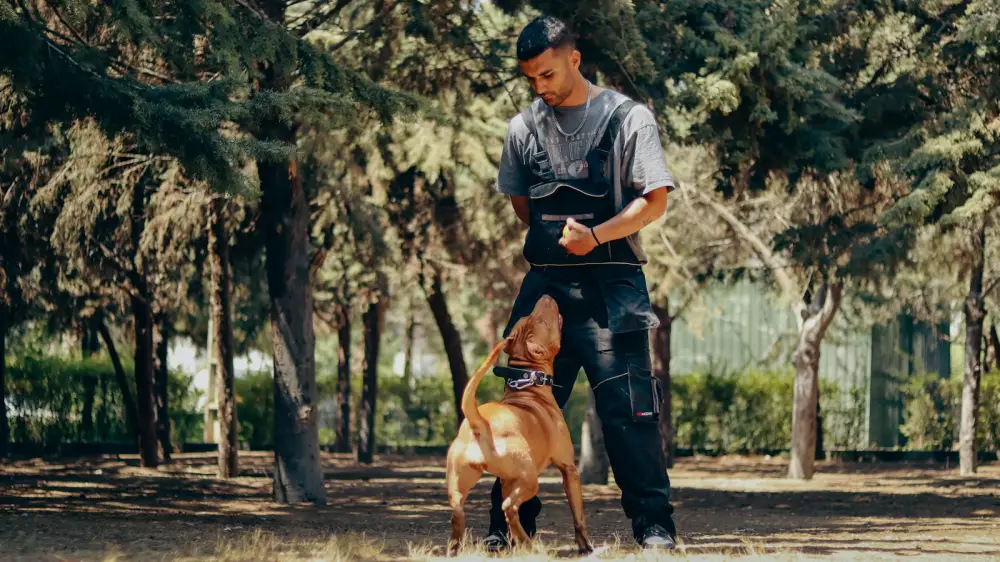
Pick an interior doorway in your house. The dog is on a leash. You approach the doorway. The dog must sit before you proceed through. You walk through first. Then you call the dog through with "free" or "okay."
If the dog tries to push through without waiting: block them with your body, restart at the sit, try again. No anger. No frustration. Just: this doesn't work, sit and wait, try again.
Practice at every interior doorway. 10 reps per doorway, 2 to 3 sessions per day. Within a week, the dog defaults to sitting at every threshold.
Phase 2: The Front Door (Days 7 to 14)
Now we apply the same protocol to the front door — but with extreme caution because failure here means the dog could escape into the street.
Always have the dog on a leash during this training phase. The front door is the highest-value threshold. The protocol is the same: dog sits, you open the door, dog holds the sit, you walk through first, dog is called through with "free."
If the dog breaks: close the door immediately, restart. Do not let the dog rehearse running through. Every successful escape sets the training back weeks.
Phase 3: Increasing Difficulty (Days 14 to 30)
Now we add challenges:
- Open the door while the dog holds the sit. Close it. Reward. (The dog learns: door opening alone doesn't mean release.)
- Step outside while the dog holds the sit. Step back inside. Reward.
- Open the door while a person walks past on the sidewalk. The dog holds.
- Open the door while the doorbell rings. The dog holds.
Each scenario is a proofing opportunity. The dog learns that the threshold is controlled regardless of what's happening on either side.
Phase 4: Off-Leash Threshold Control (Days 30+)
Once the dog is reliable on leash, transition to off-leash threshold control. The dog is in the house, no leash. You approach the front door. The dog naturally moves to follow. You give the verbal cue ("wait" or "stay"). The dog stops, sits, and waits as you open the door, walk through, and release them.
This is the mature version of the skill. By this phase, the dog has 30+ days of structured threshold work and the behavior is automatic.
The Family Protocol
Door dashing prevention requires every family member to hold the standard. The kids cannot let the dog dash through the door because the kids are coming home from school. The partner cannot let the dog through "because they're in a hurry." The visitor cannot let the dog out "because they assumed the dog was allowed."
Family rules:
- Nobody opens the front door without first putting the dog on place command or in the crate
- If the dog is loose and the door must be opened, one family member holds the dog (collar grab or leash) while another opens the door
- Visitors are briefed before they arrive: do not open this door without checking with us first
- The kids are taught the rule and tested on it regularly
A single moment of family failure can result in a dead dog. Take the protocol seriously.
Special High-Risk Scenarios
Certain situations dramatically increase door dashing risk. Plan for them:
Delivery drivers. The doorbell rings, the dog charges, the door opens. This is the most common door dash scenario. Always send the dog to place before approaching the door.
Kids coming home from school. The kids burst through the door, the dog charges past them. Establish a routine: kids enter through the garage, drop their stuff, then engage with the dog. Or the dog is crated during the after-school window until the kids settle.
Storms and fireworks. A panicked dog will dash through any open door. During storm or firework events, ensure all doors are locked and the dog is in their safe space.
Houseguests. Guests don't know your door protocol. Brief them. Or crate the dog during the guest's arrival and exit moments.
Moving day or contractor visits. Repeated door openings, multiple people coming and going. The dog goes to a secure room or crate during the entire event. No exceptions.
The Leash Backup
Even after threshold training is complete, professional dog handlers maintain a leash backup near the front door. A long lead clipped to the dog's collar that drags on the floor when guests are arriving. If the dog breaks the threshold command, you can step on the leash to stop them.
This isn't a sign of training failure. It's a sign of risk management. The cost of one door dash failure is potentially the dog's life. The cost of a leash backup is nothing.
When Professional Help Is Required
If your dog has door dashed multiple times, has been hit by a car, has escaped and been recovered, or has shown high arousal around doors that you can't manage — get professional help.
For most door dashing cases, private sessions work well because the training has to happen in your specific home with your specific door. For dogs with broader impulse control issues or for families with multiple high-risk thresholds, the 4-week board and train installs the threshold control alongside other foundation skills.
The Move
If your dog door dashes — even occasionally — do not wait. Every door dash is a roll of the dice. The fix is teachable, learnable, and reliable when properly installed. The cost of skipping the work is potentially permanent.
Book a free assessment or text 786-755-5857. We'll evaluate your home, your dog, and your family routine, and build the threshold control protocol that ends door dashing for good.
Structure creates calm. Calm creates reliability. The threshold is where reliability gets tested every single day.
Client Story
Nicole moved into a Brickell high-rise with a year-old rescue who bolted every time the front door cracked open. She had already lost the dog twice in the building's hallway and once into the stairwell. Two private sessions in, the dog was holding a place command three feet from the open door. The work was not hard — it was specific. Threshold protocol, tether for the first ten days, and Nicole had to stop opening the door the way she always had. The dog can be trusted now. The door routine cannot change.
— Nicole, Brickell
Book Private Sessions
Ready to Get Started?
Book a free assessment to evaluate your dog's behavior, discuss your goals, and find the right program. No pressure — just honest answers from a working trainer.
Book Free AssessmentView All Programs
Unleash'd K9 | North Miami, FL | unleashdk9.com | 786-755-5857
Making Sit Happen.

